Food delivery website: shawarma place, cafe, pizzeria
A website for a shawarma place, a cafe or a pizzeria: a menu with photos and extras, a cart, delivery zones and online payment.
Orders land in the kitchen’s Telegram right away, with no phone calls and no sauces lost in retelling.
The aggregator takes a commission on every order, even when someone orders from us for the tenth time.
On Friday night the phone never stops, and the cashier mixes up the sauces.
Our menu is a picture on VK, and the prices there are already out of date.
We ran out of chicken at eight, the orders for it keep coming, and we call every customer back.
What we build
Menu with extras
Sauce, lavash or pita, size, “no onion”. The price updates at once.
Delivery zones
Each zone on the map has its own minimum order, fee and delivery time. Pickup too.
Online payment
Through YooKassa, CloudPayments or another provider. The server checks the payment itself.
Orders in Telegram
The kitchen gets the items, address and phone, and changes the order status with a button.
Stop list
Out of chicken? The item disappears from the menu in one click.
Admin panel
You edit the menu, prices, photos, zones and orders yourself, no developer needed.
In detail
Pages a food delivery website needs
- A menu by category: shawarma, shawarma plates, hot dogs, drinks. Each item has a photo, ingredients, weight and price, written as text so that search engines can read them.
- An item card with extras: sauce, lavash or pita, size, “no onion”. The price updates at once, and the kitchen gets the order exactly as built.
- Checkout: address, time, a note for the courier, payment method. No sign-up, a phone number is enough.
- Delivery zones on a map, each with its own minimum order, fee and time. For an address outside the zones the site offers pickup.
- Pickup: addresses, opening hours, when the order will be ready.
- Contacts, delivery and payment terms. Payment providers usually ask for these pages when they connect a website.
What happens after “Order”
The order goes straight to the kitchen’s Telegram: items with extras, address, phone, paid or not. The cashier taps “Accepted”, then “Cooking” and “With the courier”, and the customer sees the status on the website.
Online payment goes through your provider, for example YooKassa or CloudPayments. The contract and the provider’s fee are yours. An order counts as paid only when the provider confirms the payment to the server. Purchases in Pereplyot, a bookshop in Telegram, work the same way.
The admin keeps the stop list: a sold-out sauce is switched off in the admin panel and disappears from the menu. If you work in iiko or r_keeper, orders can be passed there, if the system has an API.
The same backend can take orders in Telegram, through a bot or a Mini App with the menu, cart and payment in the chat. See the page about a shop in Telegram and the article on choosing between a website and a Mini App.
Aggregators bring new customers, but they take a commission on every order and decide where your place is shown. Your own website has no such commission, and the customer base stays with you. Move regulars to it with a QR code in the bag.
How much a food delivery website costs
| What is included | Price | Time |
|---|---|---|
| A menu website with a cart, orders sent to Telegram, payment on delivery | from $190 | demo in 1 week, launch in 1-2 weeks |
| A website with a backend: admin panel, online payment, delivery zones, statuses, stop list | from $1,100 | demo in 2-3 weeks, launch in 4-6 weeks |
| A Telegram Mini App with a menu and payments | from $430 | demo in 2-3 weeks, launch in 4-8 weeks |
The price depends on online payment, zones with different minimum orders, the number of pickup points and an iiko or r_keeper integration. Menu size barely matters if you enter the items yourself.
How people find a shawarma place online
People search for food nearby: “shawarma delivery Tomsk”, “shawarma delivery Kirovsky district”, “24-hour shawarma delivery”. The page has to answer such a query at first glance.
- The city in the title and h1 of the home page and the menu. Each city you deliver to gets its own page with its zones and prices.
- A district page only when the terms really differ there: a separate kitchen, another minimum order. Copies with one word swapped do not help.
- Prices and ingredients as text in the HTML. Search engines cannot read a menu picture, and people search for “shawarma price”.
- A Yandex Business and 2GIS listing with a link to the website, hours and delivery area. Ask for reviews there with a flyer in the bag.
- Your own food photos instead of stock ones.
- Schema.org markup for the business and the menu.
- Fast loading on a phone: people open the menu on mobile data, often outdoors.
We do not promise rankings or timeframes: they depend on local competitors and reviews.
How we work
- No spec needed. Describe in your own words what you sell and how you take orders now: phone, aggregator, direct messages.
- We estimate the work and fix the price before the start. Changes beyond the agreement are estimated separately.
- We show a demo when about 40% of the features are ready: the menu, the cart, an order arriving in Telegram. You pay after the demo, the article on payment after the demo explains why.
- Launch. The server and domain are in your name, the code and access are yours. For a month we fix texts, colours, spacing and pictures for free.
The order form collects a name, a phone number and an address, which is personal data. Under Russian law 152-FZ the website needs a consent to processing and a privacy policy. Keep prices and the stop list current too: if the website shows an old price, you sort it out with the customer.
What it looks like
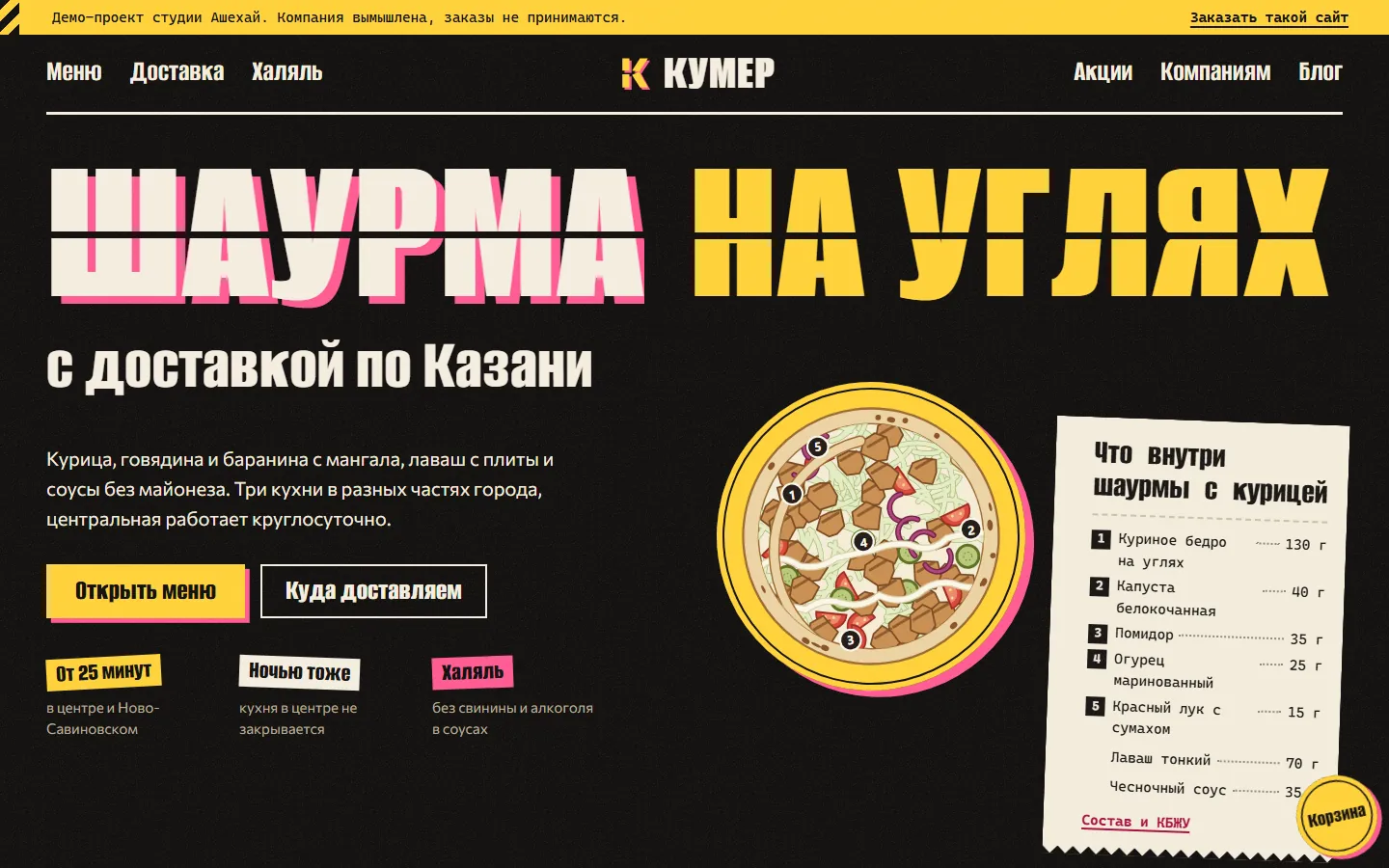
Kumer is a demo shawarma place in Kazan. It shows what a delivery site needs: a menu with ingredients and nutrition facts, a cart, and terms for seven districts with minimum orders and day and night times. The brand is made up, the cart and the delivery pricing work.
Price and timeline
Cost
Menu website with orders to Telegram
Menu, cart, delivery and pickup, orders arrive in Telegram
from $190
Delivery website with an admin panel
Online payment, delivery zones, order statuses, stop list
from $1,100
Ordering in Telegram
A Mini App with a menu, a cart and payments
from $430
Timeline
Demo in 1-3 weeks, launch in 2-6 weeks
Prices are a guide. We name the exact amount after a conversation and fix it before we start.
How we work
-
Payment after the demo
We invoice once we show a demo with about 40% of the functionality done.
-
We do the estimate
We assess the complexity and the progress ourselves and explain how we counted.
-
A month of free fixes
For a month after launch we fix small things for free, as long as they add no new features.
-
Your code, your access
You get the source code and access to the server, the bot and the admin panel. Nothing ties you to us.
Questions
How much does a food delivery website cost?
A menu website with orders sent to Telegram starts from $190. With an admin panel, online payment, delivery zones and statuses, from $1,100. We name the exact price after a conversation and fix it before the start.
Can we change prices and the menu ourselves?
Yes, in the admin panel: prices, photos, ingredients, extras and the stop list. No developer needed.
Can you connect the website to iiko or r_keeper?
If the system has an API, we connect it: website orders go to the till, and the menu comes from there. We look at your setup and estimate this separately.
Who pays for hosting and card acquiring?
The server and the domain are registered in your name and paid by you, usually a few hundred roubles a month. You also sign the contract with the payment provider, and its fee does not pass through us.
Do we need promotion?
A website does not bring orders on its own. Start with a Yandex Business and 2GIS listing that links to the site, and a flyer with a QR code in every bag. We prepare the site for search: the city in headings, prices as text, markup.
Tell us about the task
In your own words, no spec needed. We reply within a working day with a price.
Discuss a project