Equipment supplier website with a catalogue and an estimate calculator
An equipment supplier website where every model has its dimensions, power and price, and the estimate for a venue is worked out on the page.
Quote requests with the chosen models reach your manager, and articles bring buyers from search.
Half of the requests say “send us the price list”, and a manager builds each quote by hand from three files.
Buyers ask for dimensions and power, and our website only has photos and “price on request”.
People opening their first coffee shop do not know what they need. They call to ask what it all costs.
Manufacturers change prices every month, and the website is always behind the price list.
What we build
Catalogue with specs
A section for each kind of equipment and a sheet for each model: dimensions, supply, power, output, price.
Dimensioned drawings
Code draws each model from the dimensions in its card. The buyer sees at once whether the machine fits the bar.
Estimate calculator
Type of venue, floor area, new or used equipment. The list of equipment with a total is built from the catalogue.
Quote requests
A button on the model sheet opens a request with that model already chosen. It reaches your manager in Telegram or by email.
Articles for buyers
Answers to what people ask before buying: what it costs to open, which machine to take, what the sanitary rules require.
Prices from a sheet or 1C
Prices and stock update from a Google Sheet or a 1C export, so nobody edits product cards by hand.
In detail
What pages an equipment supplier website needs
- A catalogue by section: espresso machines, ovens, refrigeration, dishwashers, or whatever an industrial supplier sells. Each section has a short “how to choose” text and a list of models with prices.
- A model sheet: dimensions, weight, power supply and rating, output, warranty, price or price range. Equipment buyers compare numbers, and photos without specs are not enough for them.
- A drawing or diagram with dimensions. Buyers use it to check that the machine fits the bar and the power supply is enough, before they buy rather than after.
- An estimate for a format: coffee shop, bakery, production line. Someone opening their first place does not know the equipment list, and the estimate shows it together with a total.
- Services: turnkey projects, installation, servicing and repair. For a dealer these bring separate revenue and separate searches.
- Delivery, payment, leasing, used equipment. The website answers these before the call, otherwise the manager gets the questions.
- Articles that answer buyers’ questions, and a quote request form.
How much an equipment supplier website costs
| What is included | Price | Time |
|---|---|---|
| Catalogue website: sections, model sheets with specs, quote requests to Telegram | from $190 | 2-3 weeks |
| Catalogue with an admin panel, price list import from a sheet or 1C, an estimate calculator and dimensioned drawings | from $1,100 | 5-6 weeks |
| Prices and stock from a Google Sheet, requests and quotes back to the sheet | from $150 | 1-3 weeks |
The price depends on the size of the catalogue and on who maintains it. With a few dozen models and prices that change once a quarter, a website with the catalogue in the code is enough, and we make the edits. With hundreds of models and weekly changes in prices and stock, you need an admin panel with a database, or a price list import from a sheet or 1C. The estimate calculator, the dimensioned drawings and the articles are estimated separately.
The Latun supplier demo shows all of it: six catalogue sections with filters and comparison, 25 models with drawings, a budget calculator for three formats and 16 articles. The project price is fixed before we start.
If your price list already lives in a Google Sheet, Google Sheets automation moves prices to the website and puts requests back into the sheet. Competitors’ prices on marketplaces can be collected every day with marketplace scraping.
Why an equipment supplier needs articles
Catering equipment is a rare purchase, and the sums are large. Before buying, people spend weeks looking for answers. They want to know what it costs to open a coffee shop, which espresso machine to take and what the sanitary code requires of a place without a kitchen. The website that answered them is the first to get the quote request. That is why the Latun demo has 16 articles of 1,200-1,430 words, and each of them leads to the catalogue or the calculator.
We take topics from Yandex and Google suggestions: we type the start of a query and collect how people finish it. One article covers one cluster of queries. Facts are checked against primary sources, meaning laws in their current wording and official publications, and each article gets a date of checking. That is how the demo caught a change in the sanitary code. Since 1 September 2026 SanPiN 2.3/2.4.4282-26 is in force, and the article refers to its clauses, not to the repealed 2.3/2.4.3590-20.
Articles are estimated separately, by number and length. 12-16 articles add 1-2 weeks to the project.
How buyers find an equipment supplier in search
Buyers search with a city and a kind of equipment: “catering equipment Rostov-on-Don”, “professional espresso machine for a coffee shop”, “combi steamer for a café”, “coffee shop equipment on lease”. This is how we build the website for such searches.
- A separate page for each catalogue section, with the city in the page title and the h1, for example “Espresso machines for a coffee shop in Rostov-on-Don”.
- Specs and prices as text on the page, not in a PDF price list. Search engines need text.
- Service pages for their own searches: “turnkey coffee shop”, “espresso machine repair”, “restaurant kitchen design”.
- FAQ blocks in each catalogue section with FAQPage markup.
- Honest markup only: breadcrumbs, questions, articles. No rating or review markup without real reviews.
- Fast loading on a phone. A page of the demo weighs 82-98 KB.
- Yandex Business and 2GIS cards with a link to the catalogue.
We do not promise rankings or timeframes: they depend on competitors in your city and your niche.
Where to start
- Describe in your own words what equipment you sell, how many models you have, where the price list lives now and how you prepare quotes. No formal spec needed.
- We estimate the complexity and fix the price before we start. Anything beyond the agreement is estimated separately.
- We show a demo with about 40% of the functionality. You pay only after it, and why we take payment after the demo explains the reasons.
- We launch the website and hand over the code and access. For a month after launch we fix texts, prices and pictures for free.
You can describe the task in the request form.
A supplier’s prices follow the exchange rate and purchase costs. Under Article 437 of the Russian Civil Code, an offer to an unspecified circle of people counts as an invitation to make offers unless it says otherwise. Article 494, however, treats a retail offer that has all the essential terms as a public offer. So next to the prices we say they are approximate and the final price is fixed in the invoice or the quote. The consent to personal data processing under law 152-FZ goes into the request form from the start.
What it looks like
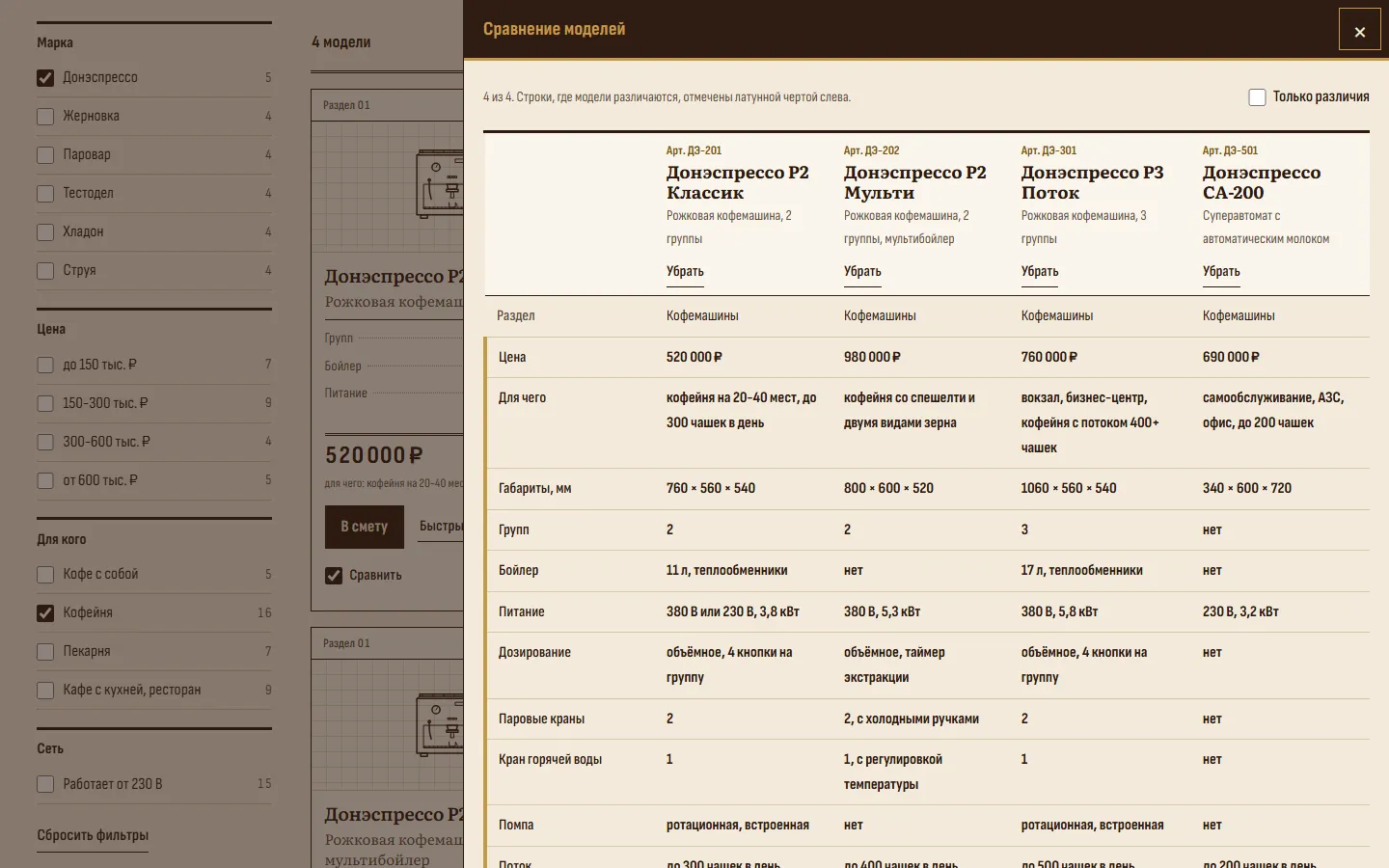
Latun is a demo supplier of equipment for coffee shops and bakeries in Rostov-on-Don, built as a catalogue shop: filters on the left, comparison of up to four models in a slide-out panel and a quote basket that turns into a quote request. Each of the 33 pages is still plain HTML at its own address, and 16 articles answer the questions of people opening a place. The company is made up, the shop, the quote basket and the calculator work.
Price and timeline
Cost
Catalogue website
Sections, model sheets with specs, quote requests to Telegram
from $190
Catalogue with an admin panel and estimates
You change prices and stock yourself, price list import, an estimate calculator
from $1,100
Prices from a sheet
Prices from a Google Sheet to the website, requests back to the sheet
from $150
Timeline
Demo in 1-3 weeks, launch in 2-6 weeks
Prices are a guide. We name the exact amount after a conversation and fix it before we start.
How we work
-
Payment after the demo
We invoice once we show a demo with about 40% of the functionality done.
-
We do the estimate
We assess the complexity and the progress ourselves and explain how we counted.
-
A month of free fixes
For a month after launch we fix small things for free, as long as they add no new features.
-
Your code, your access
You get the source code and access to the server, the bot and the admin panel. Nothing ties you to us.
Questions
Can we hide prices and write “on request”?
You can, but equipment buyers compare prices before they call. A “from” price or a range with a quote button next to it works better. Prices can be hidden for some models only, for example those shipped to order.
How many models can the catalogue hold?
The limit is not the website but who maintains the catalogue. A few dozen models can live in the code, and then we change prices for you. With hundreds of models and frequent price changes you need an admin panel or a price list import from a sheet or 1C.
Do we need a drawing for every model?
No. Code builds the drawing from the kind of equipment and the dimensions in the card. In the demo 16 kinds of equipment are drawn this way. If the manufacturer has its own PDF diagrams, they can sit next to it as downloads.
Will requests go to our CRM or 1C?
If the CRM has an API, we connect it, and amoCRM and Bitrix24 both have one. Requests usually reach 1C through the CRM or through an exchange set up by your 1C specialist. Without a CRM, requests arrive in Telegram and land in a Google Sheet.
How will buyers find the website?
Section pages with your city, articles for buyers’ questions, specs as text and search markup come with the website. We do not promise rankings. Ads can be added later as separate work.
Tell us about the task
In your own words, no spec needed. We reply within a working day with a price.
Discuss a project