Freight company website with a shipping cost calculator
A freight company website where shippers work out the price and transit time on real road distances.
Articles answer questions about paperwork and groupage, and the request with the calculation reaches your dispatcher in Telegram.
Half the calls to our dispatcher are the same: how much to take five tonnes to Yekaterinburg.
Clients find us on freight exchanges, and our own website is a single page with a phone number.
Every new client hears me explain what groupage is and why we charge by volume and not by weight.
Groupage trucks to Moscow leave on Tuesdays and Fridays, and clients only find out by phone.
What we build
Shipping calculator
From, to, weight, volume, truck, part load. Price and transit time come from road distance, not a straight line.
Route pages
Each route has its own road, towns on the way, transit time, prices by truck and a calculator with the city filled in.
Services with terms
Full truck, groupage, city vans, reefers, oversized cargo. Each page lists weight and volume limits, the price and the paperwork.
Groupage schedule
Departure days by route in one table. The client sees when the next truck leaves.
Articles for shippers
Waybills, contracts, claims, insurance, packing. Topics come from search suggestions, facts are checked against the law.
Requests to Telegram or CRM
A request with the calculation reaches the dispatcher in Telegram. If your CRM has an API, it goes there too.
In detail
What pages a freight company website needs
- A calculator: from, to, weight, volume, truck. Someone searching for “freight Chelyabinsk price” wants a total and a transit time, not “price on request”. The formula behind the price sits next to it.
- A page for each route: the road, towns on the way, transit time for a dedicated truck and for groupage, prices by truck. Searches like “freight Chelyabinsk Moscow price” land here.
- A page for each service: a 20-tonne truck, groupage, city vans, reefers, oversized cargo, storage, forwarding. The page says what you carry, the weight and volume limits and the documents needed.
- A groupage schedule: departure days by route. A client with three pallets cares more about when the truck leaves than about how many trucks you own.
- Prices as text: rate per kilometre by truck, minimum order, waiting time, extra drop-offs.
- Articles and an FAQ. Articles get their own section below.
- Contacts with a request form, company details and the warehouse address. A business client checks the company before the first order.
How much a freight company website costs
| What is included | Price | Time |
|---|---|---|
| Website with services, routes and a calculator, requests to Telegram | from $190 | 2-3 weeks |
| Website with an admin panel: rates, groupage schedule, cargo status by request number | from $1,100 | 4-6 weeks |
| Requests and runs in a Google Sheet | from $150 | 1-3 weeks |
The price depends on the calculator and on who changes the rates. If rates change once a quarter and you can send them to us, a website of ready-made pages is enough: it loads fast and costs next to nothing to host. If the dispatcher edits rates and the schedule every week and clients want to see cargo status, you need a server with a database and an admin panel. The number of cities in the distance table, a CRM or logistics software link and an account area for regular clients are estimated separately.
You can see the whole thing in our freight company demo «Ukazatel»: a route map as the home page, a calculator on roads between 21 cities, 8 routes with diagrams and 15 articles. If you also run a warehouse and store goods for clients, look at the Yarus warehouse demo in Perm and the page on a fulfilment company website.
Without a CRM, requests from the calculator can go into a sheet. Google Sheets automation sorts them by run and departure date and sends the dispatcher a morning summary.
Why a freight company needs articles
The owner of a small factory or an online shop does not ship every day. Before ordering a truck, they ask a search engine how to calculate the cost of freight and what groupage is. Then they ask which documents the driver needs and what to do if the cargo arrives damaged. An article that answers such a question brings in someone who has not yet chosen a carrier. At the end of the article sit the calculator and a link to the right service.
We take topics from Yandex and Google suggestions. A script collects them for a set of seed queries, and we see what people type in on their own. For the Ukazatel demo we collected suggestions for 55 seed queries and wrote 15 articles, among them one on the electronic waybill and one on overloading fines.
Legal facts are checked against the texts of laws, resolutions and orders. Every article has a list of sources and the date the facts were checked. Freight rules change, and an article without a check date goes stale without the reader noticing.
Articles are estimated separately, by number and length. 12-16 articles of 1,200-1,300 words add 1-2 weeks to the timeline. They can also be written after launch, a few a month.
How people find a freight company in search
People search for freight with a city, a route and a truck: “freight Chelyabinsk intercity”, “freight Chelyabinsk Moscow price”, “groupage Chelyabinsk”, “20-tonne truck freight price”. This is how we build the website for such searches.
- A separate page for each route and each service, with the city in the page title and the h1: “Freight from Chelyabinsk to Moscow”.
- Routes are chosen from suggestions. In the demo, ten routes showed up in suggestions, and pages were made for the eight with the most demand and different roads.
- Prices as text on the page: rate per kilometre, minimum order, a worked example. The calculator is for the client, search engines need text.
- Schema.org markup: breadcrumbs, questions and answers on service and route pages, publication and check dates on articles.
- Internal links: from an article to a service and a route, from a route page to neighbouring routes.
- Yandex Business and 2GIS cards with a link to the calculator.
- Fast loading on a phone. In the demo every one of the 39 pages weighs 65-79 KB.
We do not promise rankings or timeframes: they depend on competitors in your city and on your routes.
Where to start
- Describe in your own words what cargo you carry and where, which trucks you have and how you price a run. No formal spec needed.
- We estimate the complexity and fix the price before we start. Anything beyond the agreement is estimated separately.
- We show a demo with about 40% of the functionality, and you pay only after it. The reasons are in why we take payment after the demo.
- We launch the website and hand over the code and access. For a month after launch we fix texts, prices and pictures for free.
You can describe the task in the request form.
A request holds a name, a phone number and often the loading and delivery addresses, which is personal data. Under Russian law 152-FZ the website needs a privacy policy and a consent checkbox in the form, and we add both from the start. We label the calculator price as preliminary. Under Article 437 of the Russian Civil Code, a proposal with all the essential terms of a contract, addressed to anyone who responds, counts as a public offer.
What it looks like
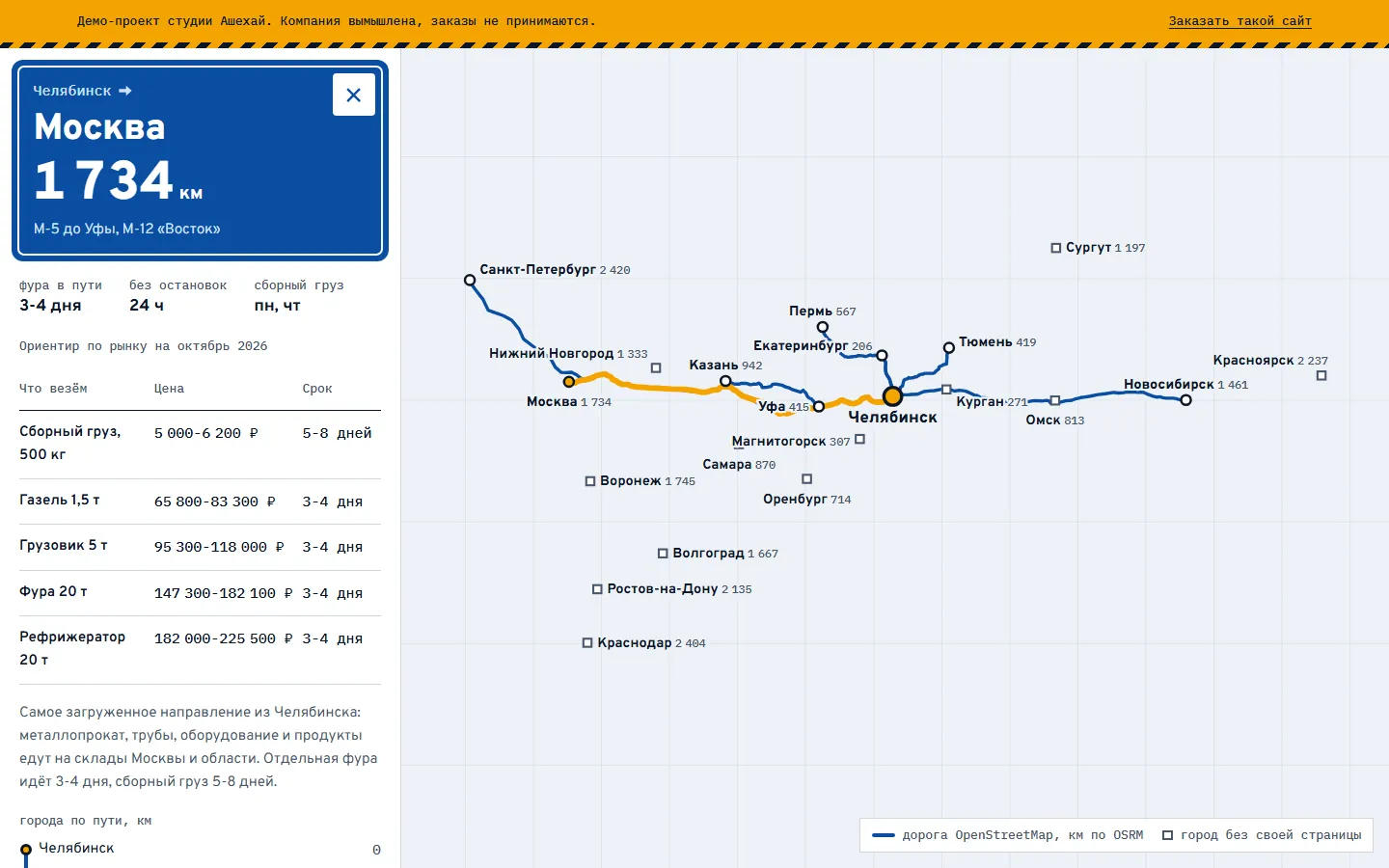
Ukazatel is a demo freight company in Chelyabinsk whose home page is a full-screen road map: clicking a city opens a panel with prices by truck, transit time and a link to the route page. Every page is still ordinary HTML at its own address, and 15 articles answer shippers’ search queries. The company is made up, the distances and the legal facts are real.
Freight company website Site format:map
Ukazatel
A demo website for Ukazatel, a made-up freight company in Chelyabinsk. The home page is a full-screen road map: a city opens a panel with prices by truck, transit time and the road. Alongside are 8 route pages and 15 articles for shippers.
Warehouse website Site format:operator console
Yarus
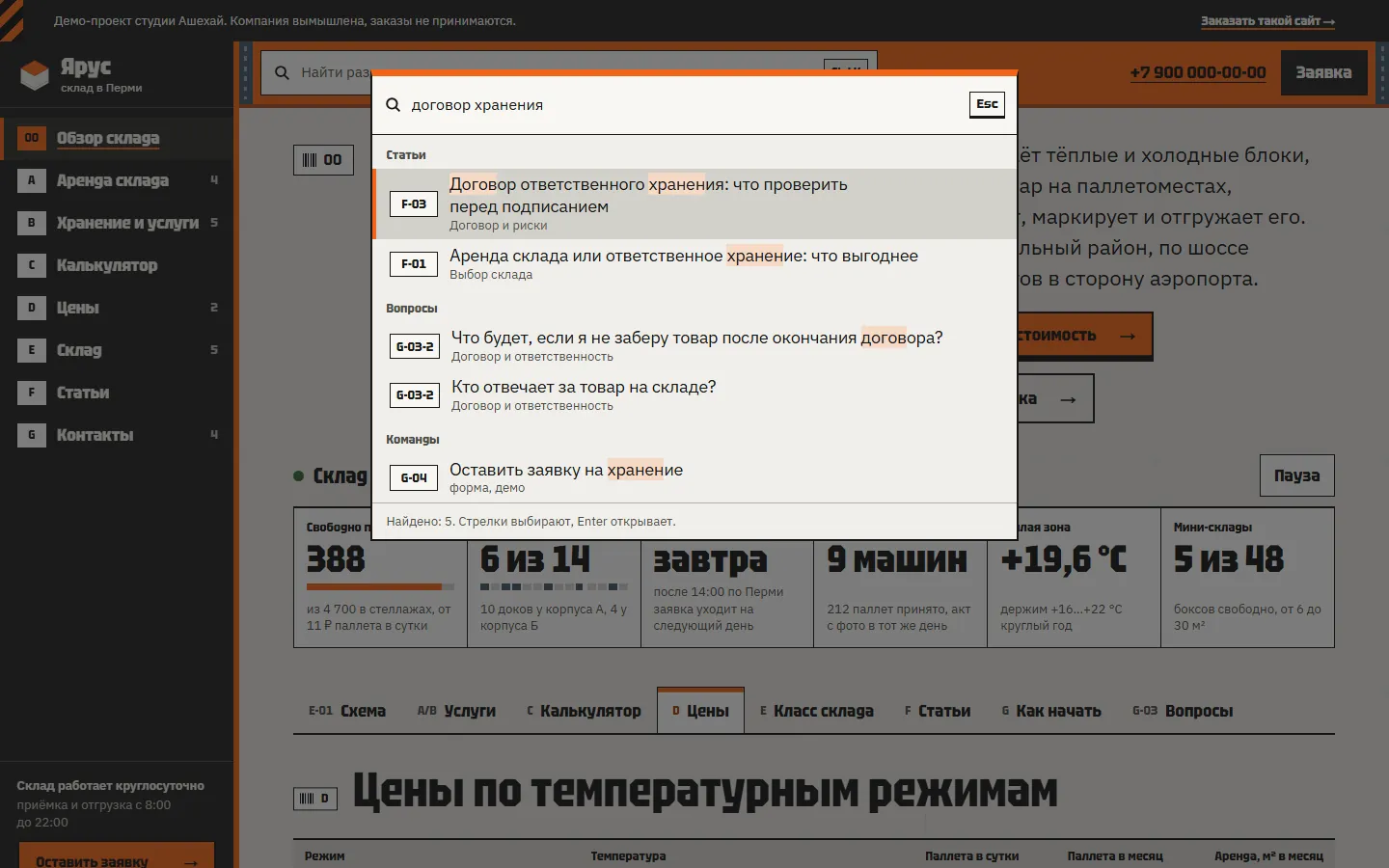
A demo website for Yarus, a made-up warehouse in Perm, built as a warehouse system console: modules on the left, search with a command palette, status tiles, tables and tabs. Inside are a storage calculator and 14 articles for owners of goods.
Price and timeline
Cost
Website with a calculator
Services, routes, a calculator, requests to Telegram
from $190
Website with an admin panel and cargo status
Rates and schedule in the admin panel, status by request number, CRM link
from $1,100
Requests to a sheet
Requests and runs in a Google Sheet
from $150
Timeline
Demo in 1-3 weeks, launch in 2-6 weeks
Prices are a guide. We name the exact amount after a conversation and fix it before we start.
How we work
-
Payment after the demo
We invoice once we show a demo with about 40% of the functionality done.
-
We do the estimate
We assess the complexity and the progress ourselves and explain how we counted.
-
A month of free fixes
For a month after launch we fix small things for free, as long as they add no new features.
-
Your code, your access
You get the source code and access to the server, the bot and the admin panel. Nothing ties you to us.
Questions
Will the calculator use our rates?
Yes. Rates per kilometre by truck, the minimum order, the short-run surcharge and the groupage tariff come from your price list. With an admin panel you change them yourself; on a simple website we change them for you, free for the first month after launch.
Where do the distances between cities come from?
From a table of road distances between your cities. The OSRM router computes it on OpenStreetMap data once, when the site is built, so there is no per-request fee to a mapping service. A new city means recomputing the table.
Can a client check where their cargo is?
We can add a status page by request number: received at the warehouse, in transit, delivered. The dispatcher changes the status in the admin panel, or it comes from your logistics software if that has an API. This needs a website with a server and a database.
Why articles, if clients come from freight exchanges?
Articles are found through searches like “how to calculate the cost of freight” or “claim to a carrier template”. Someone searching for that is not yet looking for a truck on an exchange, they are working out the task. We agree together how many articles to write, and more can be added after launch.
What about hosting and the domain?
The server and the domain are registered in your name, and you pay the provider directly. A website without an admin panel is built into ready-made pages and runs fine on an inexpensive server.
Tell us about the task
In your own words, no spec needed. We reply within a working day with a price.
Discuss a project